Working with A-Frame!

About two months ago I had the pleasure of attending a one day workshop at the School of Journalism that was an introduction to A-Frame. It was my first foray into this immersive world and really what drew me to the idea of working with A Frame for my final project was that they made it all seem so accessible to beginners.

AND… for the most part it is. There are tons of tutorials showing you how to build a basic 360 world with a box and a sphere and a cylinder. It was easy to get started in A-Frame but more difficult for me to get things how I wanted them.

Challenge 1: Getting the assets. I used my iphone and took 360 images using a google street map. This worked well, overall. However, I would have liked to be able to be able to be to create 3D images you could walk around. Maybe there is a way to do this. I haven’t been able to figure it out. I went on Sketchpad and found the perfect tree model that was a free download. I downloaded the file but I could’t get it to work properly. There is <a- glTF tag that the A-Frame website recommends using for adding models, but it when I used that, the textures from the model were absent, leaving it looking, well, strange. After some time tinkering and not able to get work it like I wanted, I decided not to use it, besides the fact that it took a lot to load into the page. It was an awesome model, however. This is a screenshot of it below. Kudos to nedo for designing it. Maybe one day I will be able to figure it out and include it in a project.

I took some images in Florida of those wonderful looking sprawling fig trees. They’ve always looked like they were going to reach out and grab me. I walked past a beautiful tree orchard on my way home from work. I think I got the pink flowers on the trees in full bloom. A few days later they were already looking greener, still beautiful, but greener. I knew I wanted to combine real with fake with this project. I wanted it to be about faded and broken memories so the images could have errors, animation, etc. I used Photoshop to smudge the images so that the background cars, people, homes were obfuscated. I spent some time working on the 360 images I already had and waited for the next sunny day to go shoot some locations I knew had some beautiful trees. And then I waited and waited some more because there was a long period of time where there was no sun and always rain. This resulted in me having to change my storyline a bit.

Challenge 2: The actual storyline and order of pages. In retrospect, I had too much going on here. I should have started with a clearer story map that was simpler and not 9 pages long. A solid 5 would have been more than sufficient. Had I gone smaller, I think I would have had more time to focus on each individual page and more importantly a through-line. Creatively, its the roughest of drafts. In fact, if I continue to work on this site, this is the main thing I will focus on – story. I feel like technical can be forgiven (depends on how much technical keeps you from story) if the story is there. I knew where I wanted to go with it, but I kept getting myself sidetracked collecting assets whether I knew for sure if I was going to use them or not.

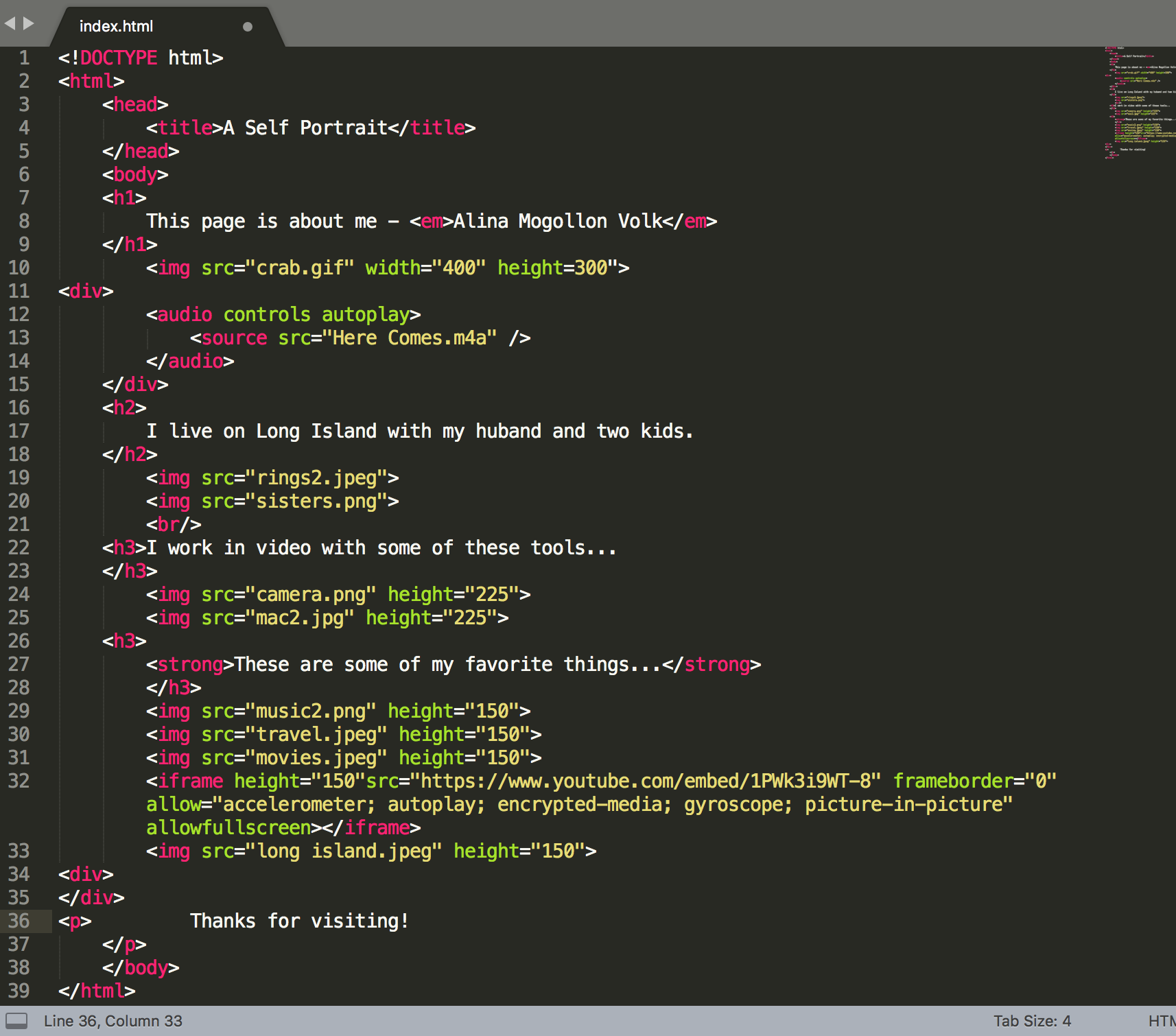
Challenge 3: And this one should seem obvious – the actual coding itself. A-Frame is kind of like HTML, but not really and knowledge of JS is definitely a plus! I made the mistake of not using a Simple server at first. That was a day wasted wondering what syntax I was getting wrong in my code. It was a throwaway line in a tutorial that gave it away. I loaded it into the server and voila! I was simultaneously ecstatic and annoyed with myself for wasting time. After that was settled, I was able to get my first basic page up with fig trees as my sky and I added text. I felt I was on my way, but alas – text. A Frame has just a few fonts you can use. Fine, once you know where to find their names (there’s no Arial or Times or Helvetica). The website was very helpful in getting text where and how I wanted on the page. I had hoped to make the text clickable or to highlight on hover. Neither of which is possible by using <a-text>. You have to use <a-entity> and then name your component as text. Honestly, doing that is not so difficult or time consuming once you know you have to do it. It took me quite awhile to figure that out. The A Frame site goes through every <a-> you can think of, but basically if you are going to play around with any of these components you need to use <a-entity>. Lesson learned. I was able to find an example of what I was looking for and used the example code to make my text fade out. I was getting somewhere! I was able to copy and paste that code into all 9 pages and made some adjustments in each for the text.

I also had some trouble with my image placement, dealing with flat vs curved images. Now that I understand and can see how things are placed on a 360 page, it seems like there is no other way for it to be. X Y Z axis. I don’t know why I had so much trouble with this, but I get it now. Also, unlike position, rotation is measured in degrees. I didn’t get why changing my rotation by 2 or 3 wasn’t yielding any changes. Then the lightbulb went off! I am loathe to admit, this happened pretty late in the game. I struggled.

Okay, and then in order to click on objects you have to add your cursor or should I say camera? <a-camera><a-cursor></a-cursor></a-camera> I could make my cursor a different color but I couldn’t figure out how to make it glow when it hovered over a clickable object. In the end I used a JS command to make the object grow in size when the mouse hovered. I was actually happy with this solution.

Unresolved to date: I’m not sure if there is a leaf command in A-Frame of some sort because my pages did not want to see a leaf.png. I finally got it to work by using an id but it took some effort. Sometimes a page would time out when it was loading assets in other folders and the asset would not appear on my page. I solved this by nesting images in multiple folders as needed. Also, I haven’t been able to get sound to work. I believe I have to create an event to make the sound play, but this seems contrary to some of the other information I found on the site. Still, half my project creatively was supposed to be sound. I would have liked to at least get the sounds of the wind playing on each page. This was a disappointment to me and probably the thing that gnaws at my brain. I want to get this to work and figure it out. Just so I can say that I can.

Challenge 4: Time! A-Frame newcomers will find a glorious world of support online. Most of it, however, is a bit advanced for newbies. Finding a steady progression of tutorials I liked that could start from the beginning take me through the different functions and possibilities was not easy. I found a few videos that helped (like the one with Simple server notice) but many were already using outdated A-Frame syntax or were beyond what I was already doing or were staying in the most basic of models. That being said, there is a ton of stuff to sort through on A-Frame’s website if you have the time to go through step by step and go back and review your JavaScript commands. In addition to time, perhaps what I need is a little added patience to waft through it all.

Conclusion: So, in the end I did produce a 9 page 360 story. I achieved my goal of having a 9 page story with clickable elements that lead you from page to page in a round robin fashion. As long you don’t click on the same image twice, you will go to every page. I learned how to manipulate the text and flat images within my page. I also got an understanding of the gaze and cursor control and how positioning works. I was able to get all my links to work the way I wanted them to work and share assets from different folders. I learned how to take 360 images with my phone. Overall, I am probably about 60% satisfied. There are a couple of pages I would change the images and I would find a way to include instructions for the user on what they are experiencing and how to enhance their experience. I also miss sound design as I do believe that would be a vital addition to the story element.

Would I use A-Frame again? Yes. Would I work on this project more? Yes. Although more likely, is that I would take my lessons from this and develop something else with some borrowed ideas. I’m just not rushing into it. A-Frame swallowed my life for about a month. At the kitchen table, walking around the house with my laptop, cursing or exclaiming, even on vacation watching tutorials. I need an AFrame break. I need a coding break. But I will come back to websites and AFrame. Now that I know they are there, they area impossible to ignore!

Internet Art

This week we read Chapter 7 of “Protocol” by Alexander Galloway, “Internet Art.” I love how the term Net.Art came about with the story how artist Vuk Cosic received an anonymous email. The only readable thing in the email was Net.Art due to incompatible software. It’s hard to believe how fast the internet has grown in such a relatively short period of time. For those of us that remember dial-up and those early AOL days, the sound of the modem calling will always be synonymous with the internet and it is so evocative that hearing it always brings me right back to the 1990s.

That sound, like other net.art, is of its time because of where the internet was in its life. As the internet has evolved so has the art that it inspires. My favorite pieces discussed are the the ebay auctions – 16 year old boy for sale! Ha!

For myself and my work, I think the internet is akin to poetry. You can be symbolic and straightforward at the same time. Users can proceed at their own pace and in the comfort of their own space. They can spend time on a single line of code or image or text and draw their own conclusions. I think I see it as a way to combine image and poetry together and I would like to explore ways that image can draw one to text and vice versa.

I’ve become more interested in VR and AR. I recently attended a workshop on AFrame and Web VR that showed me that you don’t necessarily need a headset to bring someone into a 3D world. It’s a different experience than a headset and you can build a world with that in mind.

Sleeping Through a Revolution

This letter to Millennials by Jonathan Taplin covers a lot of things. We start off with how the technological revolution has robbed artists then segue to how it has robbed our privacy and then as an extension, in essence, stolen our souls. Taplin compares us to doped out addicts. We are all addicted to something whether it be instant media, drugs, instagram. And worse, we are all the pawns of the big technological economy and we walk into the role willingly.

Of course I see truth with all these ideas. We can’t have it both ways. We can’t want to protect art and simultaneously put the artist out of work by seeking free downloads. We want to protect our privacy but not at the inconvenience of not being able to use Apple Pay. We are all very quick to enter our personal information most anywhere. We walk into danger with our eyes wide open but yet what we are addicted to is the convenience. Technology makes things easier – sometimes.

I think the movie “Wall-E” was genius. It is our modern day “1984” or “Brave New Word” when it comes to garbage, the accumulation of items and the laziness that comes when we get used yo things being a touch away. I think we are all aware of the dangers and that it is happening. I think that the acknowledgement of that awareness is what is missing from this article. We have awareness that we bury ourselves in a mountain of garbage yet we await the next revolution to awake us from our apathy. Excuse me now I have to check my feed to see whats up in the world? Grab some plastic bags while I am at it and download something on my tablet until that cultural revolution comes

Whitney Museum

March 18, 2019 we took a field trip to the Whitney Museum to see the exhibit “Programmed: Rules Codes and Choreographies in Art, 1965 -2018.”

For me, the exhibit’s showstopper is Nam June Paik’s ‘Fin de Siecle II’, 1989. An audiovisual immersion with screens running the cycle of David Bowie to blue faces to naked women to prisms and other geometric shapes the 207 console televisions took me back to the 1980s.

I went back to look at the screens a number of times. I am someone that likes to have the tv or music on in the background whenever I’m doing tasks. Even if I have the television muted or paused, I like having it there. I always have, ever since I can remember. The old console televisions were the first tvs I remember having in my house. Eventually we graduated to the black box console look. So really, the whole piece of art reminded me of growing up in a way. Granted, I don’t remember ever having video with nudity playing on a loop however I never found the nudity in this piece to be overt or overly graphic. It somehow just fit. Perhaps it was the geometric nature of the video itself and its overlapping figures. It was just shapes.

Here’s a video about how the Whitney went about restoring it:

https://youtu.be/IucNWkHI45E

Other favorites included ‘Dance’ and ‘Code Profiles’. This video takes you through CodeProfiles so you can get a look at it from home!https://youtu.be/Hs8rDvC3GZg

Week ? Poetic Computation

This week we read chapters from “The Poetic Computation Reader” by Taeyoon Choi. Choi takes us a little outside the general discussion of computers and how the technology works to consider the beauty of how they work. Computers have their own story and path that they have taken in the last century and a half and like people, have evolved. They are in many ways, more a partner or a child. We have given birth to the technology that makes today’s computers possible and then married them together.

Choi, in discussing his handmade computer project, states “I had to endure repetitive soldering and wiring. In a sense, the laborious process was a search for the poetics of computation.” Computers are created by us, he says, in part to do tasks that are laborious for us to do or that we do not wish to continuously repeat. So if this is the case, are we losing something by using computers? I do believe that there is a poetry to simple tasks ore repetitive ones. But that is mostly because it becomes a meditation. We think on one thing and focus on one thing and the rest of the world falls away. So if we look at our computers as entities so focused on their tasks that they are meditative, what then does that say about what we have lost and computers have gained?

Our computer chips, I think, our small architectural wonders. I’ve looked at memory cards and thought they were little pieces of art just from an aesthetic standpoint.If I didn’t know what it was, I could have thought of it as sculpture. Choi takes these ideas further when talking about Futurists and then quoting Walter Benjamin, “This storm is what we call progress.” Technology and art can create and glorify destruction. It has been our history that good and evil can come from the same thing and every one judges what is good and evil subjectively. Choi believes that artists can be a counter narrative to mainstream media.

I like Choi’s discussion that humans were the first computers and I remember in “Hidden Figures” the women that were hired to work on the computations at NASA were called “computers.” The definition of computer is really one who computes. So does that similarly relate to an abacus or writing pad. I don’t think so, but Choi does. I think of them more as computer parts.

Human memory vs computer memory. The computer has tried to capture how the human mind works, building connections and dropping things into folders that are easily found. It doesn’t work the same way as our brains obviously as sometimes I have no idea why one thing reminds me of another and our senses are also a big part of our memory and computers as of yet that I know, do not have our additional senses. So in some ways a computer memory is better and in some ways worse. Both human and computer memory can fail and corrupt. But I dont think the human mind would corrupt just because it has too many thoughts/memories. Its about the ability to recall the information not the memory itself. Some would say that every memory is in our subconscious. Some people, like Marilou Henner, with hyperthymesia are able to recall every day of life somehow. Her recall is controlled by processing by date. Not everyone with the condition is as lucky as they are prone to getting lost in memories. Our subconscious may be protecting us from too many memories so we may move on with our lives. Just like playing too many video games or living in a virtual world may make us not want to live in our current one.

The discussion on privacy and its importance is most interesting to me in the section where Choi quotes the students. Student 1 says that privacy is insulation from social norms, and allows one a space to develop ideas and grow and perhaps act differently than they would otherwise. Of course privacy is important for these reasons. The darkside to that as everything else, is that technology allows for a certain anonymity that has given birth to online trolls and people that feel free to say terrible things about others without fear. It can bring forth the worst sides of people because of an increased ability to isolate ourselves from technology. As we hide, we also lash out.

Week 4 – The Rise of Network Society

This week we read chapter 1 in Manuel Castells’ 1996 book, “The Rise of Network Society.” It’s titled “The Information Technology Revolution.” My thoughts… I actually find the history of technology to be rather interesting. The evolution, a rather fast evolution, is due to so many factors that came together in an almost perfect storm. Might the revolution of computers come a little faster? Perhaps. Equally possible, is that any set of changes could have delayed the onset of this very blog by decades. Still, I found this reading a little dry in places. There is a lot of content and the places where I was most engrossed were the ones that tried to put the happenings into context.

I agree with Castells that it is not just one thing that brought on this technological revolution. We can not simply point to the Cold War as the reason that computers were so important. The term revolution is key here, because as innovation grew, more people were drawn into its web (pun intended) as part of said revolution. One piece of technology inspired another piece of technology and so on until we have where we are at today. The revolution is indeed an evolution of technology and that is thanks to economic factors, idealism, the military, the open source nature of the technology that made it exciting for people with years of experience and with relatively little experience to want to do something, try something.

I never thought of the parallels with bio technology, specifically with the human genome. It shows the importance of the openness of the technology. When everyone has access, it breeds greater opportunity for others to get involved and push things forward.

week 3 – Reading

When I was a kid, we had a Commodore PET computer in my elementary school library. As rewards during class, we would sometimes be given time to go down to the library and play on the computer. I remember a game that let you advance by naming state capitals. There was another game that let you make decisions to find your way out of rooms. There were no graphics. It was typing. It was floppy discs. I remember in high school we had computers that were set up for word processing in a computer lab connected to a dot matrix printer that made that distinctive sound as it printed out from its connected sheets. I admit that I never imagined that so much of my life would eventually come to depend on the computer interface.

Len Manovich writes in the intro to “The Interface” and in “Software Takes Command” how we must consider the interface when we think about web art and, really, the web in general. Now with a variety of browsers and add on extensions, there are multitudes of ways we can view content. We don’t even really have to see content in the way the designer has planned if we don’t want to on our web servers. Artists can use and develop extensions to create the art work that they want and to enhance either a viewer’s experience or be part of the spectacle itself. Not only that, but the computer itself provides a different experience depending on the system it uses.

My experience as a computer user has changed drastically in the past decades as my experience with different computers and different interfaces has evolved. I’ve always been a Mac lover and don’t enjoy using a PC as much. However I prefer the Android interface to the Apple OS when it comes to tablets and phones. When Windows makes a big change to its system people either rant or rave. I’ve cursed out loud at the realization that upgrading to a new OS has left old software I loved unusable. It is a bit of science fiction when you think about it and the fact that AI is being used to write commercial and to interact with users. We are heading into “Blade Runner” category.

In my house we have all types of computers. We have old and new laptops. We have old and new desktops. I still keep my old Mac G5 as a back up. We know that the need to run new and better software requires a new and better machine. I’ve heard say that the second you buy a computer, its already obsolete because there’s already something better developed somewhere. But there is a commonality. Manovich discusses the idea of “remediation.” It’s a constant building of what came before. Keeping what works and what we are comfortable with and making it better. We are used to seeing things a certain way and working with things a certain way. Change is good but then I remember how I felt when Apple did away with the Final Cut 7… “media after software” indeed.

Eventually, I think things will continue to evolve. Ebooks don’t look like paper books anymore. I agree with the thought that its an evolution. It may only seem slow because we are spoiled by how fast the whole computer revolution has been overall but just in my lifetime I’ve seen it change completely.

week 2 – Reading

“As We May Think” by Vannevar Bush, an article published in “The Atlantic” in 1945, essentially predicts the modern age of tablets/smartphones and other tiny devices. He starts off with the notion that it is already possible to record high volumes of information. Microfilm, records, etc, stenographs already existed for this very reason. However, how to easily access the information? It is one thing to say you can carry around some microfilm in your bag, it’s another to print out hundreds of pages of its information so you can actually read it and show it to others.

“Whenever logical processes of thought are employed—that is, whenever thought for a time runs along an accepted groove—there is an opportunity for the machine.” But it goes beyond straight logic. Strict manners of thinking are great when working on a formula, but real life application of logical thought in non-mathematical terms requires the programing of more computations. Beyond this, it’s one thing to have all the knowledge of the world at your disposal but what good does it do you if you can not easily get to it or worse, if sorting through to find what you’re looking for is so time intensive and exhaustive that you don’t have the time to actually spend on the information you are trying to study.

He mentions how the human mind works by association. That’s often how today we deal with things on the web. There are many times that I think randomly of something and google it. Not because I need to know something so suddenly, but simply because I can. It can be simple, like a song lyric that was in my head in the morning, or thinking that someone on a television show looks familiar and so I hop on IMDB to find out where else I have seen her. “Consider a future device for individual use, which is a sort of mechanized private file and library. It needs a name, and, to coin one at random, “memex” will do. A memex is a device in which an individual stores all his books, records, and communications, and which is mechanized so that it may be consulted with exceeding speed and flexibility. It is an enlarged intimate supplement to his memory.” Of course, Bush here is imagining a giant computer of some sort, a piece of furniture and not a pocket sized kindle that can access the libraries of the world and this is pre-internet where you must imagine that all knowledge must be loaded directly on to the computer and no accessed across networks.

Bush wonders if someday it will be possible to make the introduction of the knowledge even easier – perhaps a direct connection from the brain to the machine. Maybe we think its far fetched today, but everything seemed far fetched at some point. Bush would not have been able to conceive of the smart phone or smart watch. These were things we saw even later on in the Jetsons as being something from a future far far away. But in a relatively short time, its here. Who is to say what technology will bring us tomorrow. Skynet? we will see.

In “Modernist Painting” by Clement Greenberg, the idea that stood out to me was that Modernism is about pushing the boundaries of art in its current state. You must look at your limitations and push against them or knowingly incorporate them into your work. Over time, Modernist work has become more “flat” and less sculptural. Greenberg posits that Modern Art is closer to science than ever before because it draws from a consistent methodology. It works within its own form without borrowing from others. Like the scientific method, it follows the trajectory of its own hypothesis. Modern Art, he says is self critical and the best art is personal. Yet, like all art before it, it is not always aware of itself in the moment.

I think it’s interesting how ties to the webolution can be drawn. Digital and web art cannot be haphazard. Choices should be made with a reason just as an artist makes a deliberate choice to paint flat vs sculptural. It’s not just simply doing something different for the sake of being different, but it’s an ongoing evolution. And what is emerging media. It’s name itself is telling you its an evolution. Just like what Greenberg says of Modern Art, emerging media tests theories about how we experience art and makes us question what we enjoy about art and how it makes us feel.

“Long Live the Web” by Tim Berners-Lee is a concise breakdown of the history of the web as it pertains to the end user -us and why it should be important to us that certain rights are protected. I was in college in the 1990s and I remember asking one of my computer engineering friends what the internet was. He told me that every time I sent an email I was using the internet. When I was on a group chat or used cross university messaging, I was using the internet. The thing I didn’t use so much at the time was the world wide web and that was primarily because it was ridiculously slow and loading a page on to my Mac Classic II. My little Mac was a workhorse however. At the time, I thought it was fast. It did everything I needed it to do and with 80MB of memory I had plenty of space for all my world processing documents!

It’s astonishing looking back now how fast it all changed and how the web has become such an integral part of my life and the world. It’s such a slippery slope dealing with all the issues of the web. We are getting to the point in our existence to lack of access to the internet is a potential detriment as governments seek to control their peoples. The web is great because its open, because there is so much. Some of us are too connected and some may not be enough, but with everything in a free society, it is a choice. With so much information on the web and some institutions (including libraries) closing or shrinking we need to provide more people with access to the internet.